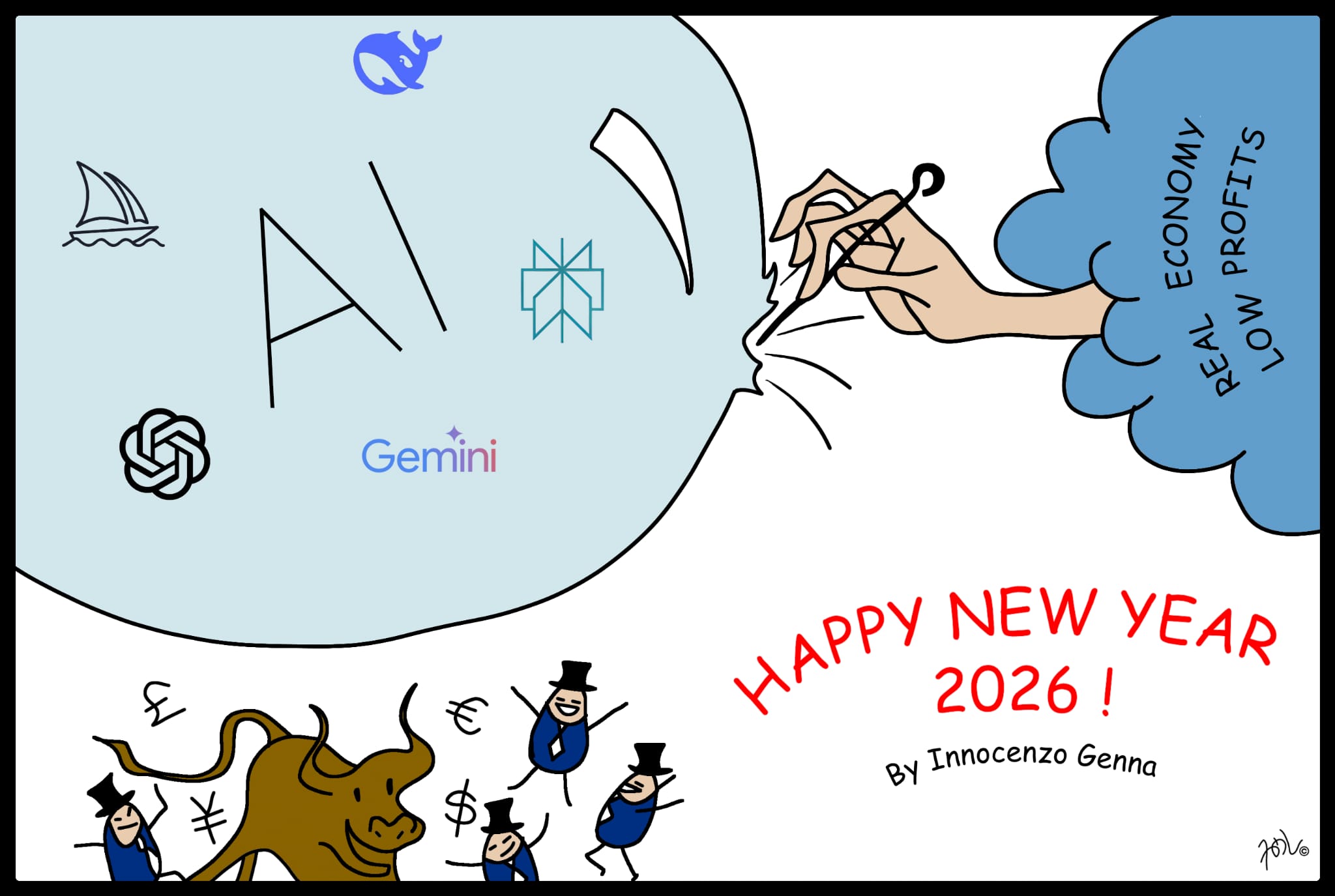
As the telecom and tech community welcomes 2026, it is tempting to believe that the “AI decade” has finally and irreversibly arrived. Yet the numbers and the industrial dynamics suggest something more fragile: an AI investment cycle that increasingly looks like a speculative bubble, whose bursting has become at least plausible – and perhaps imminent.
From New Year cheer to AI bubble fears
Over the last two years, AI has become the master‑narrative underpinning network upgrades, cloud strategies and spectrum forecasts across our industry. Data‑center build‑outs, backhaul planning and edge deployments are all being justified by projections of exponential AI demand. At the same time, however, the basic financial equation of this boom remains deeply uncomfortable: capital is pouring in at a pace that is not matched by sustainable cash flows or profits for most of the actors that sit above the hardware layer.
What makes the current moment distinctive is not just the size of the numbers, but their imbalance. A narrow group of chip vendors and cloud providers is already minting money on the AI wave, while a much broader ecosystem of model companies and application startups is burning cash at a rate that would have looked alarming even in the dot‑com era.
Capital raised vs. cash actually earned
At the heart of the bubble hypothesis lies a simple mismatch: unprecedented fund‑raising and valuations against chronically negative free cash flow.
– The flagship model companies have raised or are targeting capital in the hundreds of billions of dollars, yet they remain structurally loss‑making. Publicly discussed projections for at least one leading frontier‑model provider point to cumulative negative free cash flow well above 100 billion dollars over the next few years and no expectation of turning cash‑flow positive before the end of the decade.
– Revenue is growing fast, but losses are growing even faster. Margins are crushed by the cost of compute, energy and talent, as well as by the need to sell below cost to capture market share. In many cases, AI application providers spend more than their entire revenue on upstream model APIs and cloud infrastructure, effectively subsidising their own customers while enriching the infrastructure layer.
– By contrast, the small cluster of winners at the bottom of the stack – GPU manufacturers and a handful of hyperscalers – are already enjoying extraordinary returns. Their profitability, however, does not automatically validate the valuations and business models of the dozens of companies higher up the stack that depend on cheap capital and heroic growth assumptions to survive.
In telecom language, the system looks like a heavily leveraged operator betting that future ARPU will eventually catch up with a fibre roll‑out that has already saturated its balance sheet – except that, in AI, there is not yet a clear view of the tariff model that would deliver that ARPU.
Declining barriers: the DeepSeek moment and beyond
If this imbalance were protected by unassailable barriers to entry, the bubble could perhaps be rationalised as an expensive but controlled land‑grab. The problem is that those barriers are already eroding.
– The DeepSeek family of models has demonstrated that near‑frontier performance can be achieved at a fraction of the apparent training cost of Western “flagships”, with some weights released openly and API prices set an order of magnitude below incumbent leaders. This is not just a technical achievement; it is a pricing shock that challenges the narrative of permanent, proprietary moats at the model layer.
– Analysts have noted that DeepSeek and similar open‑weight releases are rapidly compressing the gap between closed and open models on benchmarks that matter in practice, such as coding, reasoning and multilingual capabilities. For many enterprise and public‑sector workloads, “good enough and cheap” will be more attractive than “slightly better and extremely expensive”.
– As training recipes, datasets and optimisation techniques diffuse, the real bottlenecks are shifting towards access to energy, chips and favourable regulatory environments. In other words, barriers are moving down the stack, away from the model layer where a large part of today’s valuations are concentrated.
For telecom and infrastructure professionals, this should sound familiar. A generation ago, vertically integrated incumbents also believed that controlling end‑to‑end infrastructure would guarantee long‑term rents. Over time, open standards, over‑the‑top players and commodity hardware squeezed margins in exactly those segments that had looked safest.
Why the bubble is politically propped up
Under normal market conditions, such a configuration – huge losses at the application and model layer, extreme concentration of profits in hardware and cloud, and declining technological moats – would argue for a cooling‑off period. Instead, the AI trade is being politically and financially propped up.
– On the macro side, AI‑related investment and wealth effects have become a key pillar of recent US growth. The surge in data‑center construction, chip manufacturing and AI‑linked capex has helped offset the drag from tariffs and trade frictions, making the AI boom a convenient counter‑narrative to concerns about protectionism.
– At the policy level, the Trump administration has embraced AI as both a productivity engine and a geopolitical asset. Strategic documents present AI as central to US competitiveness, and the official line emphasises acceleration of private AI investment and deployment rather than prudential cooling or aggressive antitrust scrutiny of AI‑driven concentration.
– On the corporate side, Big Tech needs the AI story to sustain today’s valuations and to justify massive, multi‑year capex programmes. A sudden repricing of AI expectations would not just hurt a few speculative startups; it would risk dragging down the market capitalisation of some of the largest companies in history and, with them, the perceived success of the current economic policy mix.
The outcome is a probable convergence of interests between the administration and AI‑exposed Big Tech players. Both sides have strong incentives to “kick the can down the road”: tolerate enormous losses at the model and application layers, discount environmental and system‑risk externalities, and maintain a narrative in which every negative cash‑flow projection is rebranded as a rational investment in future general‑purpose productivity.[1]
How long can this last?
No bubble can be sustained indefinitely by narrative alone, even when narrative aligns with political convenience. For our community – engineers, economists, regulators and lawyers in telecom and digital infrastructures – the real question for 2026 is not whether an AI bubble exists, but what could finally puncture it.
Several triggers are conceivable:
– A tipping point where open and cheap models, including successors to DeepSeek, fully commoditise a large share of AI workloads, making it impossible for high‑burn proprietary players to defend premium pricing.
– A macro or financial shock that closes the funding window for multi‑billion‑dollar, loss‑making AI ventures and forces a hard repricing of risk across tech.
– A political turn – perhaps driven by energy constraints, labour backlash or security incidents – in which the same policymakers who today celebrate AI as growth magic decide that the social and fiscal costs of propping up the bubble have become too visible.
When that moment comes, the underlying technology will of course survive. AI will remain embedded in networks, operations and services much as IP did after the dot‑com crash. What will not survive is the current expectation that almost every firm touching AI is entitled to a “future monopoly” valuation, regardless of its unit economics.
So let this New Year message end with a modest wish for 2026. May our sector continue to explore and deploy AI where it genuinely adds value – in optimisation, automation and decision‑support – while keeping a sober eye on the financial and political engineering that currently shields the AI bubble from gravity. In telecoms, we have seen bubbles inflate and burst before; the networks we are building now should be robust enough to outlive this one as well.
Categories: Uncategorized
 radiobruxelleslibera